
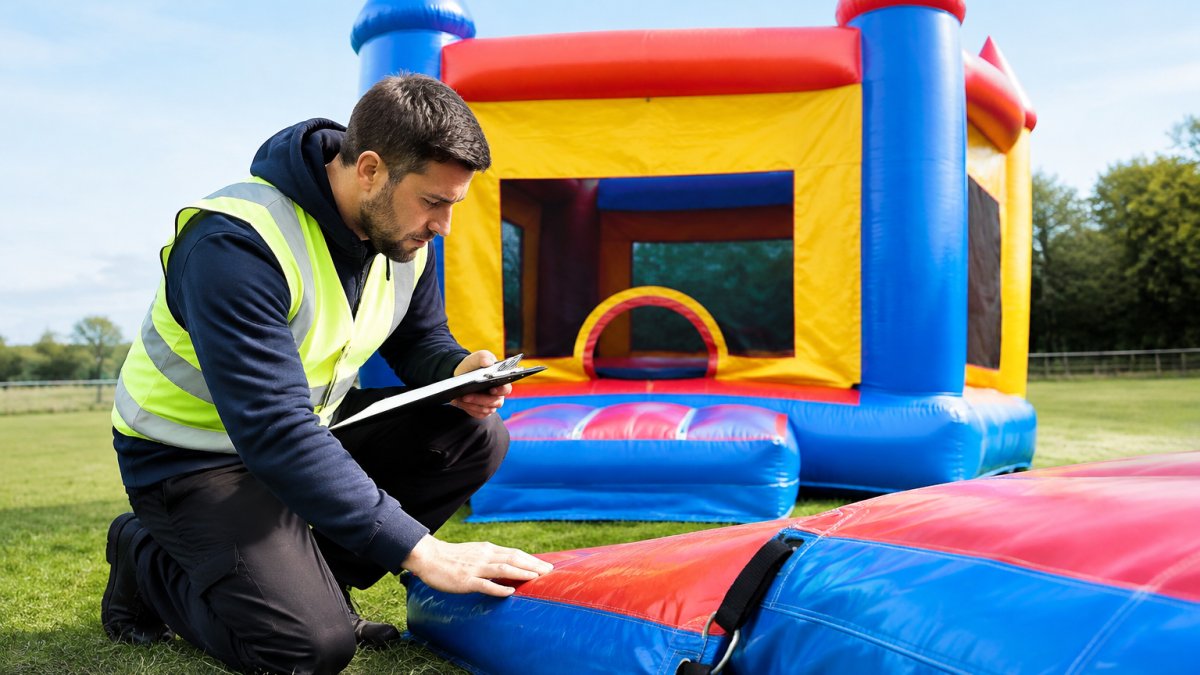
Last Updated: November 9, 2026
Quick Summary
A bouncy castle safety checklist covers eight checks: ground and overhead space, access for the blower, anchorage, a full inspection on the day, written supervision rules, wind and weather monitoring, capacity limits and an emergency plan. We cancel hires when winds of 19-24 mph (Force 5) are forecast, with a full refund.
- A 4m x 4m castle needs roughly 5m x 5m of clear space, measured at the lowest ceiling point.
- On grass use ground stakes at every anchor point; on hardstanding use sandbags or water ballast.
- Run a five-minute inspection after setup, checking seams, mats, stakes and the blower before the first bounce.
- One adult should supervise as their only job, with shoes, glasses and hard items removed first.
- Mini castles suit ages 1-5, while larger castles and the slide suit ages 6 and up, never together.
Table of Contents
- What Belongs on a Bouncy Castle Safety Checklist in 2026
- Bouncy Castle Setup Checklist: Space, Access and Power
- Anchorage and Securing: Stakes, Sandbags and Ballast
- Bouncy Castle Inspection Checklist: What to Look For on the Day
- Bouncy Castle Safety Rules for Children and Supervising Adults
- Bouncy Castle Weather Safety: Wind, Rain and When to Stop
- Capacity Limits, Age Segregation and Overcrowding
- Electrical Safety, PAT Testing and the Blower Unit
- Emergency Procedures, Deflation and Incident Reporting
- Book Your Safety-Checked Inflatable for 2026
- Frequently Asked Questions
What Belongs on a Bouncy Castle Safety Checklist in 2026
A bouncy castle safety checklist is a structured set of checks covering setup space, anchorage, equipment condition, supervision rules, weather limits and emergency procedures, completed before and during every hire. At Big Bounce Kingdom, we have hired inflatables around Watford since 2012, and the same eight checks decide whether a party runs smoothly or ends early. Below, we break down each one so you know exactly what to look at, when, and why it matters.
The eight checks that matter before anyone bounces:
- Ground and overhead space measured against the unit's real footprint and height
- Safe access route for the blower and the delivery team
- Anchorage: stakes in grass, sandbags or ballast on hardstanding
- A full inspection of seams, stitching, mats and stakes on the day
- Written supervision rules agreed with every adult present
- Wind and weather monitoring, with a clear stop threshold
- Capacity limits and age segregation enforced from the first bounce
- Emergency plan: who deflates, who clears the area, who calls for help
Most guides list these as boxes to tick. The real skill is knowing which ones fail in practice. In our experience, it is nearly always the space measurement and the wind call, not the equipment itself.
Bouncy Castle Setup Checklist: Space, Access and Power
Measure the lowest point of the ceiling, not the middle, and check the narrowest door on the route in. A 4m x 4m castle needs roughly 5m x 5m of clear space, and overhead obstructions such as light fittings, beams and basketball hoops catch people out far more often than floor area does.
Our Polar Bear, for example, stands 5.05m tall. Check the clear height your venue needs against the castle's live listing before you book. Before the van arrives, confirm:
- The flat, clear footprint, with toys, garden furniture and anything sharp removed
- The lowest ceiling point along the whole run of the castle, not just the centre
- Access width and any steps between the van and the setup spot
- A standard plug socket within reach of the blower cable
Castles arrive rolled up, so a very narrow doorway limits you to the smaller units. If you are unsure which model fits, our guide to choosing between toddler and large inflatables walks through the size differences.
Anchorage and Securing: Stakes, Sandbags and Ballast
Anchorage is the single most important physical safety feature on any inflatable, and it must match the surface. On grass, ground stakes driven through every anchor point at an angle hold the unit; on hardstanding, sandbags or water ballast replace them. An unsecured castle in a gust is a genuine hazard, not a theoretical one.
Every hire from Big Bounce Kingdom includes pegs or sandbags, safety mats and the blower as part of the quoted price, so there is no separate anchoring kit to source. What we ask of you is simple: point out the surface type when booking, and keep the anchor points clear once we have set up. Never move a secured castle, and never let anyone play with the stakes.
Bouncy Castle Inspection Checklist: What to Look For on the Day
A five-minute inspection after setup catches almost everything worth catching, but only if you know what a fault actually looks like. Walk the whole unit before the first child steps on, and look at it the way a professional would.
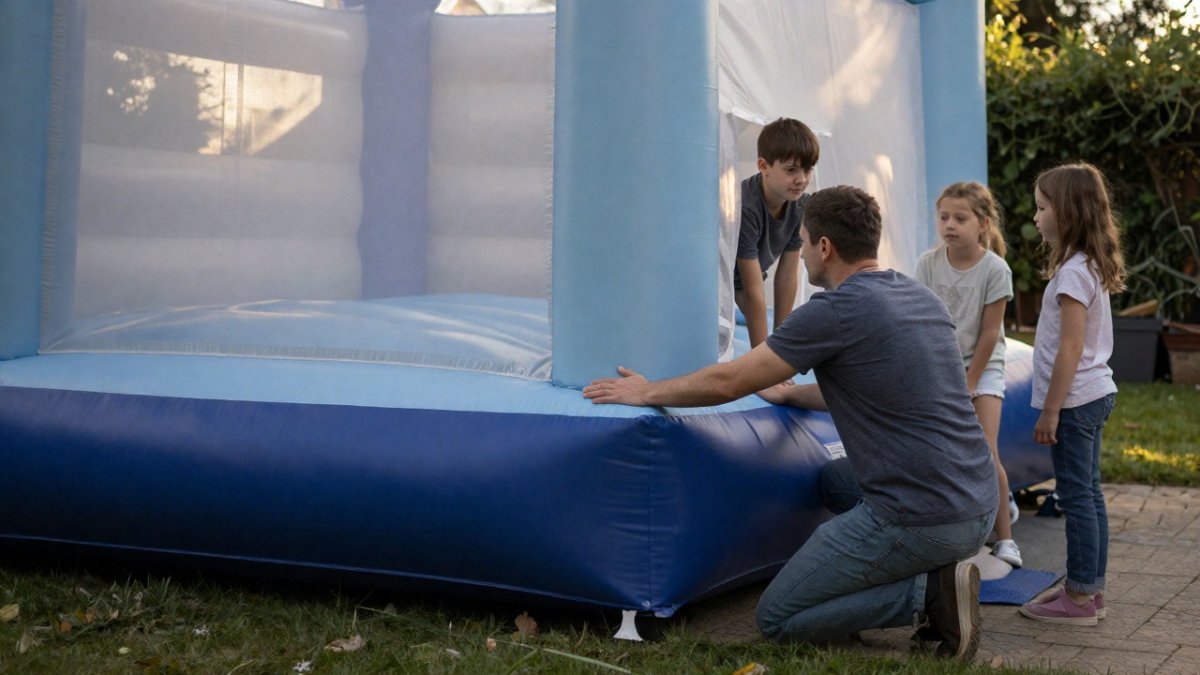
The five-minute parent inspection after setup:
- Every anchor point staked or ballasted, with no slack in the ties
- Seams and stitching intact, with no fraying, tears or exposed threads
- Safety mats in place at the entrance and exit
- Blower running steadily, tube connected and unobstructed
- No sharp objects, pet mess or debris inside or around the unit
- Castle fully inflated and firm, with no sagging walls
- All children briefed on the rules before the first bounce
How to spot red-flag wear and tear
A checklist only helps if you can read what you are looking at. Run your hand along the seams at the corners and around the entrance, because that is where stress concentrates. Frayed stitching, a seam that has started to open, or a patch of fabric that feels noticeably thinner and shinier than the panel beside it are all stop signs.
Check the anchor ties and the D-rings they attach to as carefully as the fabric. A tie that is worn thin, or a ring that has started to pull away from its stitching, will not hold when a gust arrives.
The blower is part of the inspection
A bouncy castle stays firm only while the blower keeps pushing air through it, so treat the blower as a safety component, not an accessory. With the unit inflated, listen for a steady note rather than a surging or rattling one, and check that the tube is fully sleeved over the outlet with no gap or twist. Feel the tube along its length for soft spots or kinks.
Watch out: if the castle starts to soften while the blower is still running, get everyone off, switch off at the socket and call the hire company rather than adjusting anything yourself.
If anything looks wrong, stop and call the hire company before use.
Bouncy Castle Safety Rules for Children and Supervising Adults
Rules only work when one adult owns them. Before anyone bounces, agree who is supervising, and make it their only job for the session. Our bouncy castle safety tips for parents and supervisors cover the full briefing in detail; the essentials are below.
- Shoes, glasses, badges and anything hard or sharp come off first
- No food, drinks or balloons inside the castle
- One at a time on the slide, feet first, no climbing the walls
- No somersaults, wrestling or hanging off the netting
- Keep the entrance clear and never let children pile up at the doorway
- Stop play immediately if the castle starts to soften or shift
A common mistake is treating supervision as a shared background task. It is not. One adult, watching the castle, phone in pocket.
Bouncy Castle Weather Safety: Wind, Rain and When to Stop
Wind is the deciding factor, and the threshold should be agreed before the day. Big Bounce Kingdom cancels when winds of 19-24 mph (Force 5) are forecast, and if we cancel for wind or unsafe weather you receive a full refund.
Most guides stop at quoting a number. The harder part, and the part that actually keeps children safe, is reading the wind on the day and knowing when to call it. That is the gap this section fills.
Reading wind speed on site
Check the forecast the day before and again on the morning, and look at the gust figure rather than the average. Phone weather apps usually show both; if yours only shows an average, treat the day as windier than it looks.
On site, an anemometer gives you a real reading at the castle rather than at the nearest weather station, and handheld models are inexpensive. If you do not have one, the Beaufort scale is a reliable fallback. Force 3 (around 8-12 mph) lifts leaves and paper and keeps light flags moving. Force 4 (around 13-18 mph) raises dust and moves small branches. Force 5 (around 19-24 mph), the point at which we cancel, is when small trees sway and you feel resistance walking into the wind.
When to stop play mid-party
Agree the stop signal with the supervising adult before the first bounce, and act on it without debate. Stop play and deflate if any of the following happens:
- The castle leans, shifts or pulls against its anchors
- The walls ripple continuously rather than settling between bounces
- The blower note changes or the unit starts to soften
- Loose items around the garden begin to blow over
- You can hear wind in nearby trees or feel it pushing you as you walk
Deflating is not a failure of the party; it is the correct call. Once the wind drops and stays down, the unit can be reinflated and play resumed, but never while a gust is still building.
Rain, wet ground and slippery fabric
Rain alone rarely stops a hire, but wet fabric gets slippery and wet ground loosens stakes. Light drizzle with no wind is usually fine; heavy rain combined with any breeze is the point to call it. After rain, check that the stakes still hold firm before letting children back on, because softened ground is the most common reason an otherwise secure castle starts to move.
Watch out: a bright, still morning does not guarantee a calm afternoon. Gusts often build through the day, so re-check the forecast at lunchtime and keep the anemometer or the Beaufort read to hand rather than trusting the morning's conditions.
The Beaufort scale gives you a reliable read on the wind when you do not have an anemometer to hand.
| Beaufort band | Wind speed | What you see |
|---|---|---|
| Force 3 | Around 8-12 mph | Leaves and paper lift, light flags keep moving |
| Force 4 | Around 13-18 mph | Dust rises and small branches move |
| Force 5 | Around 19-24 mph | Small trees sway, you feel resistance walking |
Wind speed
Capacity Limits, Age Segregation and Overcrowding
Overcrowding causes more injuries than equipment failure, and it is entirely preventable. Mini castles suit ages 1-5, while larger castles and the slide suit ages 6 and up, and the two groups should never bounce together. Different weights and different confidence levels are a poor mix.
Set a number before the party starts and hold it. If children are queuing, run timed turns rather than letting "just one more" in. Our guide to toddler versus large inflatable hire explains why age separation matters so much for the smaller units.
Watch out: a castle that looks empty can fill in seconds when a game starts, so count heads at the entrance rather than trusting a glance at the walls.
Electrical Safety, PAT Testing and the Blower Unit
The blower is the one part of the setup with mains power running to it, so treat it with respect. Every electrical item Big Bounce Kingdom hires out is PAT tested, and we carry £2 million public liability insurance. Our frequently asked questions cover insurance and safety arrangements in full if you need confirmation for a venue or school.
In practice, that means:
- Keep the blower upright, dry and well away from the entrance
- Never cover the blower or block its air intake
- Route cables where nobody will trip, and keep them out of puddles
- Do not let children touch the blower or the power supply
- Switch off at the socket before any adjustment
If a blower cuts out, get everyone off the castle first, then investigate.
Emergency Procedures, Deflation and Incident Reporting
Know the deflation plan before you need it. If the castle starts to lose pressure, or the wind picks up, the supervisor clears the unit, switches off the blower and lets it deflate fully before anyone goes near it. Rehearse that sequence with a second adult so two people know what to do.
For anything more serious, stop play, administer first aid and record what happened, including the time, the children involved and the equipment condition. Report the incident to the hire company the same day, even if it seems minor. An inspection log of what was checked and when protects everyone, and it helps the operator spot wear before it becomes a fault.
Book Your Safety-Checked Inflatable for 2026
Safety is not a document you sign; it is a set of habits repeated at every hire. Every hire follows the same routine: castle dimensions published upfront, a full setup by our team, and clear rules handed over before we leave.
Every hire includes delivery, setup, collection, blowers, extension cables, safety mats and pegs or sandbags, delivered and collected the same day. You can browse our full range of castles and slides to check sizes and live prices, or contact our team with any question about your venue.
The checklist above only works if the equipment underneath it is sound.
Frequently Asked Questions
What should be on a bouncy castle safety checklist?
A working checklist covers eight areas: a site survey for space and access, correct anchorage with stakes or sandbags, a visual inspection of seams and stitching, a secure blower connection, PAT-tested electrical equipment, clear supervision rules, capacity limits and a weather plan. Big Bounce Kingdom includes delivery, setup, blowers, extension cables, safety mats and pegs or sandbags in every hire, so those items are handled before you sign anything. Ask for the public liability insurance certificate and check the castle's size against your garden before booking.
How do you check that a bouncy castle is safe to use?
Start with the paperwork: ask for proof of public liability insurance and confirmation that electrical items are PAT tested. On the day, inspect the seams, stitching and anchor points, confirm the blower is running at firm pressure and that the castle does not sag or shift. Check that safety mats sit at the entrance and exit, and that ground stakes or sandbags are secure. Ask questions during setup rather than after, so you understand the unit before children use it.
How should a bouncy castle be anchored?
Anchoring depends on the surface. On grass, ground stakes driven through every anchor point hold the castle, while sandbags or other ballast are used on hard standing where stakes cannot go in. Never rely on the blower's weight alone, and never tie a castle to a fence, vehicle or other structure. Big Bounce Kingdom supplies pegs or sandbags as part of the hire and secures the unit during setup. Check the anchor points yourself before children start bouncing.
What safety rules should children follow on a bouncy castle?
Remove shoes, glasses, badges and anything sharp before entering. No food, drinks or balloons inside the castle. Children should bounce away from the entrance, avoid somersaults and never climb the walls or netting. Keep the age groups separate: mini castles suit ages 1 to 5, while larger castles and the slide are for ages 6 and up. One adult should watch the castle at all times with no other job, and the number of children inside should stay within the operator's stated limit.
When should you stop using a bouncy castle because of the weather?
Stop when winds of 19 to 24 mph (Force 5) are forecast, and evacuate the castle if gusts pick up suddenly. Big Bounce Kingdom cancels bookings on that forecast and gives a full refund if the weather forces cancellation. Rain makes the surface slippery and should pause use until it passes. Check the forecast the day before and again on the morning of the event, and keep a phone handy with a wind speed app so you can monitor conditions during the party.
What should you do if a bouncy castle starts to deflate?
Get everyone off immediately and calmly, then check the blower. Common causes are a disconnected hose, a tripped plug socket or a blower that has been switched off. Reconnect the hose and confirm the blower is running before letting anyone back on. If the castle continues to lose pressure, stop using it and call the hire company. Never let children stay on a partially deflated castle, as the walls lose their shape and falls become more likely.

Planning a party?
Browse the full range, check live availability and book online in a couple of minutes.
See all castles

